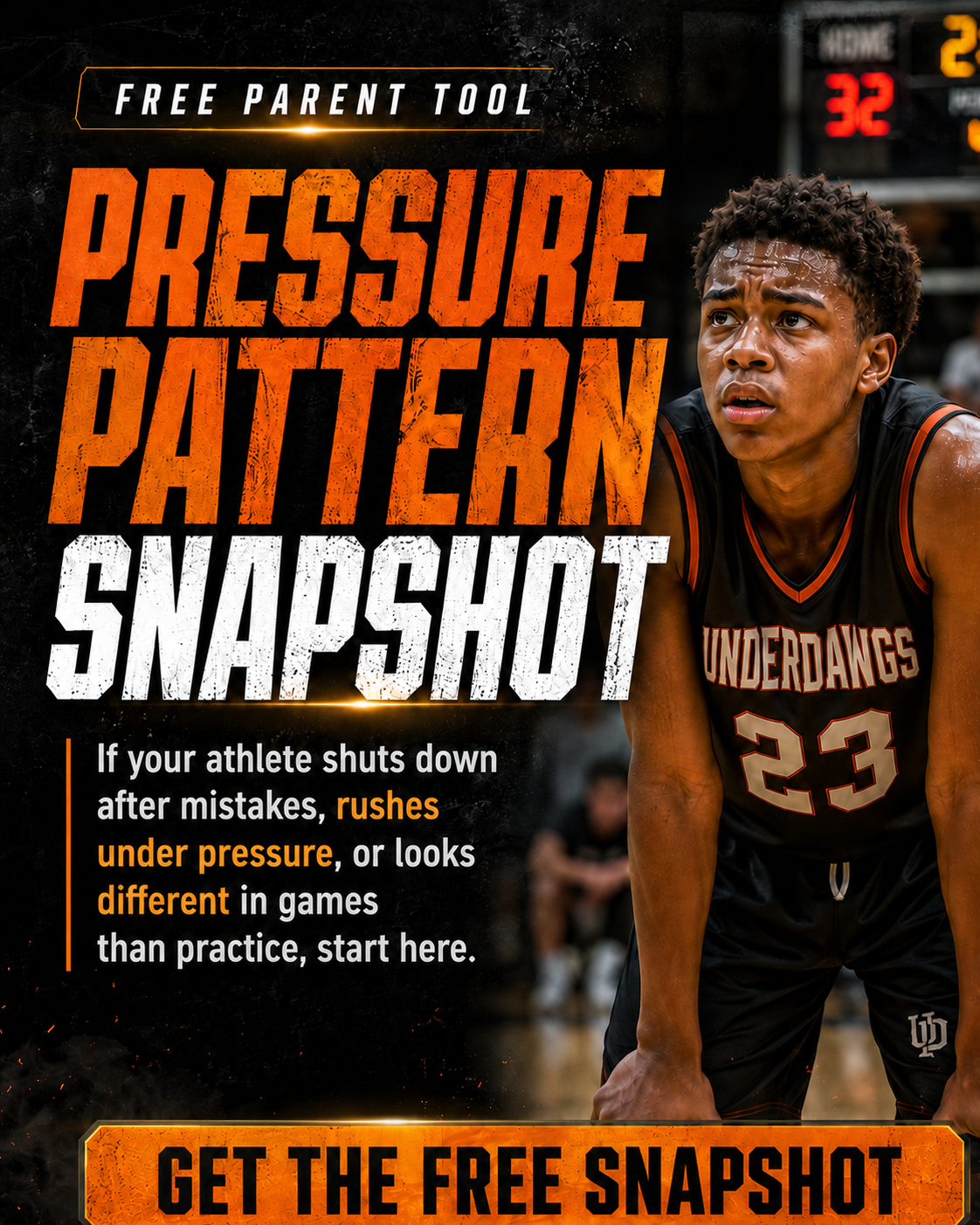
What happens after your athlete makes a mistake?
I help athletes recognize their response after mistakes, reset, and recover faster so one difficult moment does not become the rest of the game.
“She didn’t put her head down after missing shots like she usually does. She didn’t look frustrated. She was just different. I had never seen her play like this before.”Adam, Maura’s father
The visible shift was not that Maura stopped making mistakes. It was that her response after the mistake changed.
The bad play is the moment. The response afterward is the pattern.
Your athlete does not need a label. They need help recognizing what changes after mistakes, corrections, tougher competition, or frustration.
The Mistake Spiral
One mistake carries into the next few plays through rushing, forcing decisions, frustration, or slower recovery.
Identify This PatternThe Overthinking Response
Pressure changes decision-making. The athlete hesitates, second-guesses, plays safer, or looks unsure after the difficult moment.
Identify This PatternThe Quiet Shutdown
Pressure shows up as disconnection: less communication, lower engagement, passive play, or disappearing from the game.
Identify This PatternStart where your family is right now.
You do not have to commit to coaching just because the behavior sounds familiar.
Free Pressure Pattern Snapshot
Use one recent game or practice to identify the response that showed up after the pressure moment.
- Six quick choices
- No essays or judgment
- Immediate pattern result
- One behavior to watch next
Underdawg Elite Private Coaching
Eight weeks of direct athlete coaching focused on recognizing the response, building a reset, and recovering faster in real pressure moments.
- Personal coaching and weekly response training
- Proof-of-action check-ins
- Game-specific reset and recovery work
- Parent and coach observations used as progress evidence
Parents should be able to see the response changing.
The goal is not fake confidence or perfect games. The goal is a more trained response after mistakes, feedback, and pressure.
Reset and return to the next play
Listen, adjust, and stay connected
Keep the same effort and presence
Take ownership without spiraling
Use a response instead of carrying it
Recover in fewer plays
Recognize the response. Build the reset. Train faster recovery.
Parents are not paying for motivational conversation. They are investing in a structured process that connects coaching sessions to visible behavior in real games and practices.
Recognize
Identify what changes after mistakes, feedback, role changes, or tougher competition.
Reset
Build a simple response the athlete can use before the next action.
Apply
Use the response in real basketball moments, feedback situations, and pressure environments.
Recover faster
Strengthen ownership, consistency, communication, and transfer beyond the coaching session.
What parents noticed when one mistake stopped controlling the next play
“Before working with Coach Que, Cam’ron struggled with controlling his emotions and decision-making under pressure. One mistake would snowball into frustration, anger, and disappointment. The biggest change has been his recovery after mistakes. He now uses ‘next play’ to reset instead of spiraling.”
Precious, Cam’ron’s mom“Before this, one mistake would make Gianna fold—she’d start second-guessing everything. Now when the moment gets tight, she resets and keeps playing. No spiraling. No shrinking.”
Cherise Brown, Gianna’s mom“My daughter used to feel boxed in—scared to try things because she didn’t want to mess up. Coach Que helped her play as herself, make decisions, and learn through mistakes without getting stuck in her head when pressure showed up.”
Dara Hart, Nasia’s mom“Coach Que didn’t just train my daughter—he gave her structure for staying composed under pressure. She learned how to communicate, lead, and respond when things didn’t go her way. That carried over into school too.”
Donnel, parentBuilt from real games, real families, and real pressure moments.
I kept seeing skilled athletes change after one difficult moment.
A missed shot changed the next possession. A correction changed body language. A tougher opponent changed decision-making.
Underdawgs Voice was built to help athletes recognize that response, reset intentionally, and recover faster instead of carrying the moment through the game.
I understand the parent side too. I watched my son play football and my daughter play basketball. I have sat where sports parents sit, watching talent show up differently once pressure enters the moment.
- 10+ years coaching youth and high school athletes
- Former head girls basketball coach
- AAU coach and director experience
- Full-time educator
- Father of athletes

Coach Que | Pressure reveals training
Help your athlete recognize the response, reset, and recover faster.
Use the free Snapshot when you want immediate clarity. Request a private fit review when the pattern is already clear and your athlete needs direct coaching.
Private 8-week coaching: $997 or three payments of $375.